
The Difference is
in the Details
For lawyers, algorithms, and next-generation large language models alike, zoning codes are anything but easy to comprehend. They can be contradictory, poorly formatted, and layered with cross-references that demand human judgment. That's why we employ trained analysts to ensure our data captures the nuances of even the most complex codes.
Land Use Labs zoning data does not rely on AI. And that makes all the difference.
After reading over a million pages of zoning codes, we've seen it all: codes without maps, maps without codes, codes that contradict their own maps, and codes that contradict themselves. Automated scraping tools and AI can't resolve these problems — because the answers aren't in black and white. They’re found in conversations with local planners, clerks, and GIS specialists.
There are no shortcuts when it comes to data accuracy. That's why our data is triple-vetted:
1. Trained Analysts: Our zoning and GIS analysts apply the National Zoning Atlas's open-source methodology to translate unstructured texts and maps into a unified, comparable dataset. When the code and the map don't agree, they pick up the phone.
2. Experienced Professionals: Every analyst submission is reviewed by senior planning and GIS professionals with decades of combined experience. Their expertise is the quality control layer that automated tools simply can't replicate.
3. The Public: Our Atlas will always remain freely available to the public. That transparency isn't just a public service; it's a form of peer review. Local experts catch things that even the best internal process might miss, so we welcome the scrutiny.
Land Use Labs draws from a time-tested methodology originating with the National Zoning Atlas to collect and maintain zoning data, and has developed additional protocols for new products and custom analysis.
Learn the Methods Behind our Products
-
Item description
-
Land Use Labs has the most accurate and most comprehensive collection of zoning data currently on the market. Painstakingly collected by experienced planning professionals, our data covers more than 100,000 zoning districts.
We construct zoning district data through a standardized methodology designed to translate complex local regulations into consistent, comparable data. For each jurisdiction, our analysts collect and review the full zoning ordinance—both text and map—logging as many as one hundred rules for each district. District boundaries are digitized and spatially aligned, while regulatory attributes specifying use, lot, and structure characteristics are encoded into our structured data schema.
To ensure consistency across jurisdictions, all districts are processed through a multi-stage validation workflow. Analysts apply standardized definitions to harmonize zoning rules across places, enabling the direct regulatory comparison across geographies. Quality assurance reviews evaluate internal consistency, confirm alignment between mapped boundaries and written regulations, and document how ambiguities are resolved. Districts are only included in the final dataset after passing these checks, producing a verified, nationally consistent layer of zoning regulations ideal for mapping, policy analysis, comparative research, city and regional planning, and more.
-
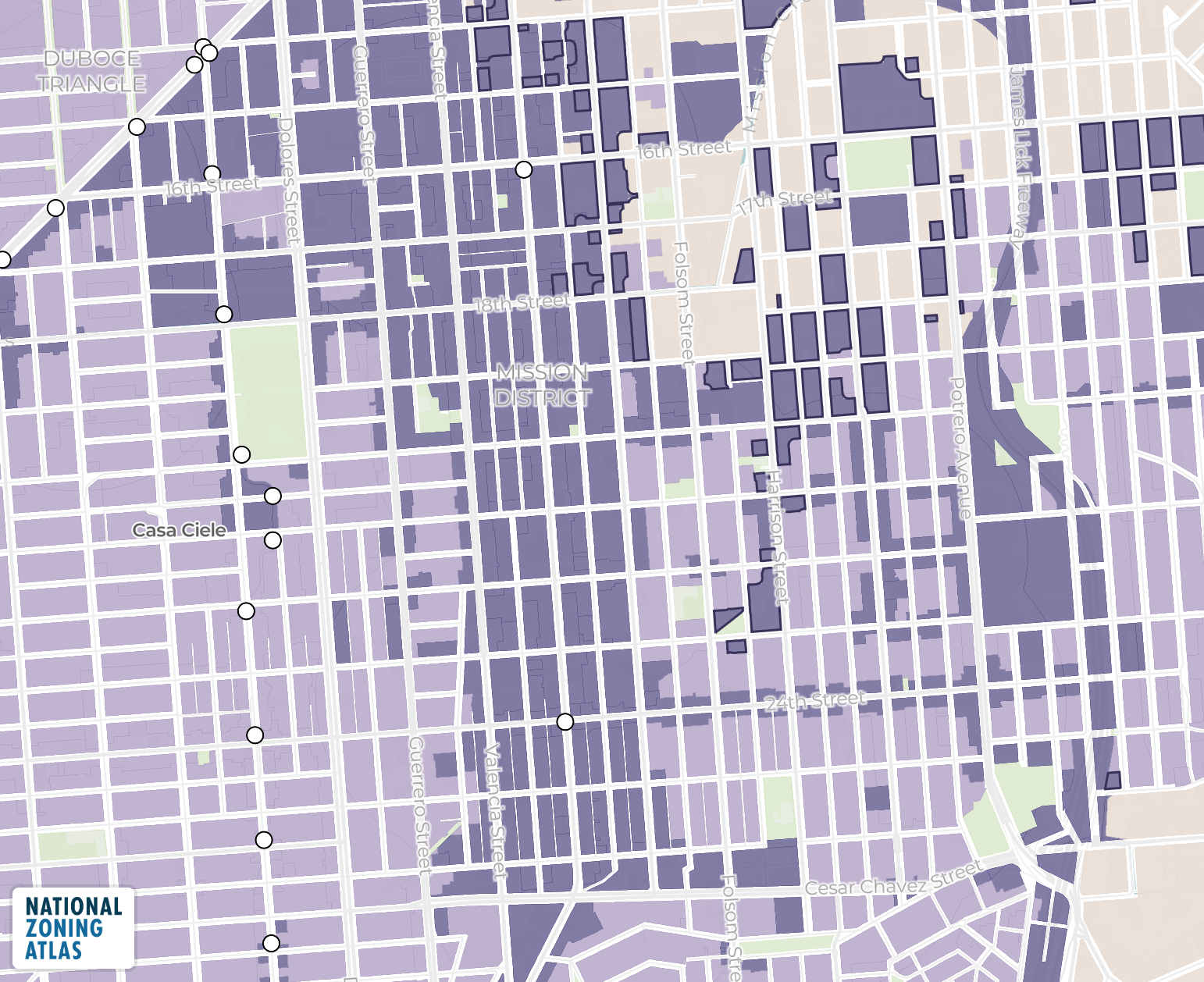
Zoning Slices are constructed to represent the combined effect of multiple overlapping zoning regulations on a single geography. Because zoning codes frequently layer overlay districts on top of base districts, a single location may be subject to multiple—and sometimes conflicting—rules. To address this, we generate Slices by merging base districts with all applicable overlays, producing unique geometries where the full set of governing regulations can be evaluated together. This approach avoids analytical errors that can arise from treating base and overlay districts independently.
We currently maintain around 150,000 Slices. To create them, we stack up layers of regulatory information about all districts governing a specific parcel or group of parcels and then “flatten” the layer into one. Where one overlay sits atop a base district, the overlay’s conflicting regulations prevail. Where there are two or more overlays, we attribute the most restrictive regulation to the Slice. We developed this process to facilitate the accurate display of a complex regulatory environment on the National Zoning Atlas map and Zoning Snapshots and to enable further statistical analyses.
-
Item description
-
Description text goes here
Long live accessible zoning data for everyone.
By licensing our data, you support the National Zoning Atlas.
Land Use Labs is a mission-driven social enterprise created to ensure the NZA — the country's most authoritative zoning resource—stays current, free, and available to all.